If your survey will be conducted within a company, and you want to make a study about the attitude of the employees, the size of the population is obvious; the number of employees. But if you are studying the possibility of success of a new product on the market, the size of the population is not so obvious, since you should consider the potential buyers of the product. Therefore, determining the target population is a critical step in the completion of your survey. The population refers to those subjects that compose the universe of people or things that have the attributes that you want to study.
Once we know the population of the survey, the next step is to define how many people should be interviewed. Interviewing everyone in the whole population (census) would be ideal; in this way we could be very accurate and comprehensive and we could conclude easily about people�s behavior. However, in practice this is normally impossible, due to the costs, logistics and time required to collect all the data. However, a small representative sample of the population can scientifically reflect the performance of the overall population. The larger the sample, the more accurate results will be, however, large samples will yield almost the same results as scientifically selected small samples. So, large samples produce a waste of effort, time and money. You should make the decision about the size of the sample based on factors such as the time available for the study, the budget you have and the precision level you want to achieve. Use the Sample calculator shown at the menu on the left to help you in this process.
It is important to say that to avoid bias in the results, the sample data must be representative and randomly selected, however in some cases you may take intentional samples, but with some degree of randomness to avoid problems.
Although there are several methods and criteria to define the sample size, Rotator prefers to leave this activity in the hands of the researcher. However, for basic users we recommend the following formula, which can be used to estimate the sample size. At the left of the screen, there is a calculator that uses this formula. Just click on "Calculate sample" to estimate your sample.
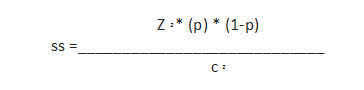
Z = Z Value (For example: 1.96 for a 95% of confidence)
p = Selected percentage, expressed as a decimal (0.5 has been used)
c = Confidence Interval, expressed as a decimal (for example 0.04 = �4)
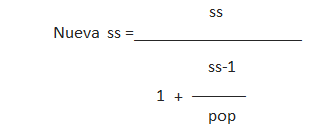
Where pop= Population�s size
(*) In practice, both formulas throw very similar results. That is the reason why most users prefer to generalize and use the first formula.
A quota is the size of a subgroup that conform the sample. It is useful to set quotas to ensure that the overall sample reflects the relevant proportion of the total population�s subgroups. For example, everybody knows that men and women have different opinions about different situations of life. Therefore, in order to balance the study, you may select a number of men and a number of women proportionally to the actual population. Or for example if you are interviewing users of certain products, you may select a sample of users of products A, B and C according to the proportions of their market shares.